
The Iran War has generated massive upheaval across the Middle East and beyond, with the most immediate impact being the blockade of the Strait of Hormuz.
The blockade has restricted the flow of crude oil and LNG from the Middle East, which in turn has fed into higher oil prices that have created a cost-of-living squeeze for businesses and consumers.
The Strait of Hormuz, along with the Straits of Malacca, Taiwan, Gibraltar, Suez Canal, Bab-el-Mandeb, the Panama Canal and the Mozambique Channel, are all widely regarded as major chokepoints.
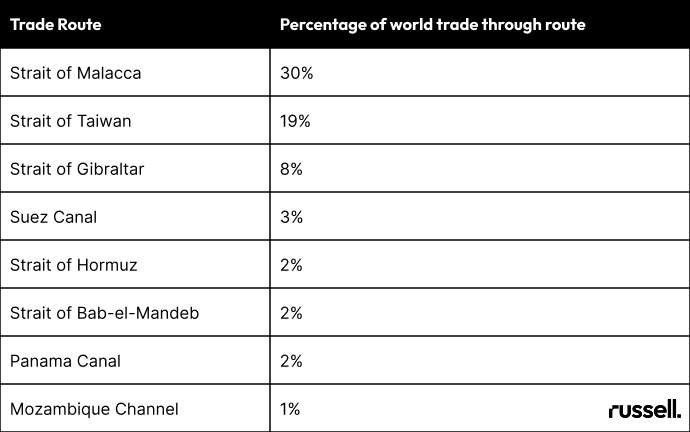
As our analysis below shows, these chokepoints play a vital role in moving trade around the globe. See table 1 below: Percentage of trade through each global trade route.
The Strait of Hormuz, while dominating the headlines is not the largest route by value, with that accolade belonging to the Strait of Malacca, a vital gateway linking global trade to East Asia. In a sign of shifting trade from west to east, nearly 50% of all global shipped trade runs through the Strait of Malacca and Taiwan combined.
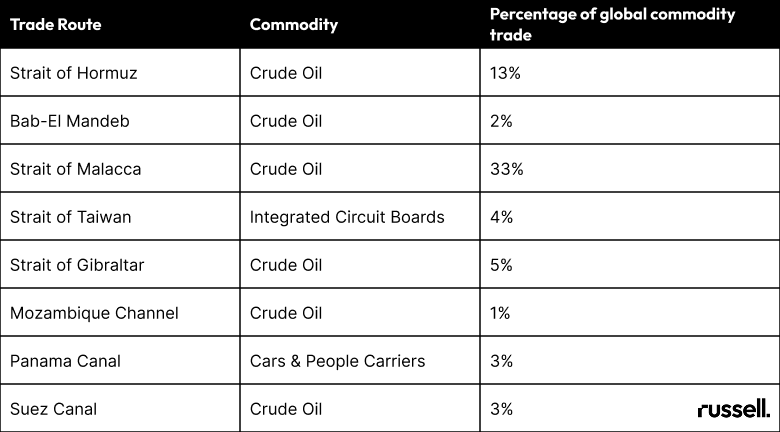
However, the picture shifts, when viewed through commodity trade, with 55% of global seaborne crude oil trade transiting the Straits of Hormuz, Malacca, Gibraltar, Bab El-Mandeb and Mozambique Channel combined. See table 2 below: Annual commodity trade through global chokepoints.
It is tempting to write off the current focus on global chokepoints, as a passing fad that will be replaced by another concern in a years’ time, but that would be misguided.
The disruption created by the blockade of the Strait of Hormuz has shown that monitoring global chokepoints needs to be a priority for marine underwriters. Such an approach would help them to effectively calculate and understand their true exposure from future events.