

For as long as containers have moved cargo around the world, poor securing of the packages stowed within has quietly driven a disproportionate share of the losses. In 2019, National Cargo Bureau’s (NCB) Container Inspection Safety Initiative examined 500 containers, free of charge to the industry, including US imports and exports as well as both dangerous goods (DG) and non-DG shipments, to uncover the hidden dangers that exist on every voyage. The finding was stark: 43% of the containers inspected had deficient securing of the cargo inside. Seven years later, the pattern holds, pointing to where industry gains are waiting to be made.
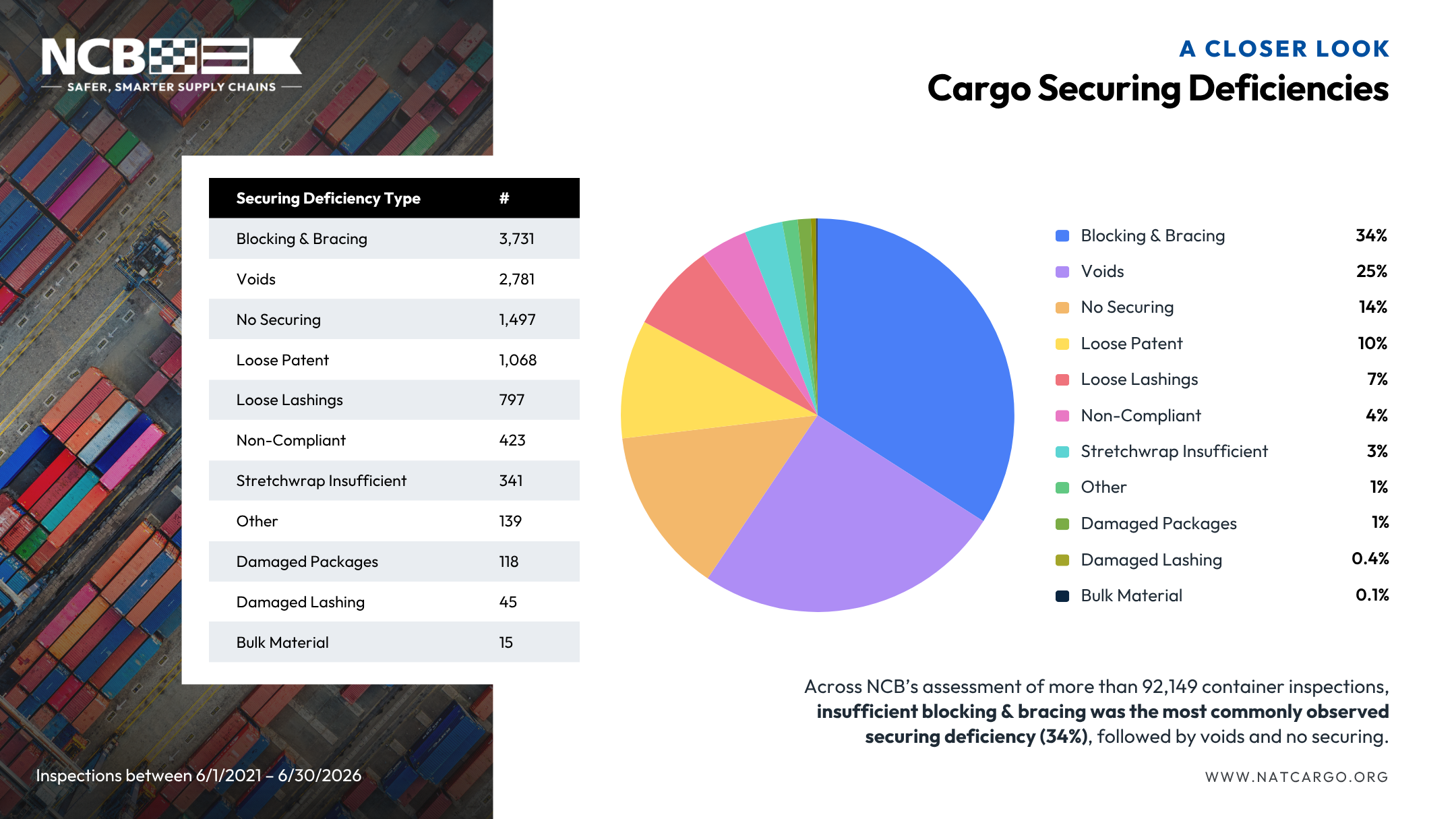
Between June 2021 and June 2026, NCB conducted more than 92,000 inspections spanning DG containers, DG tanks and non-DG units, as well as more than 50,000 flat racks. The overall failure rate for containers settled at nearly 16%, with deficiencies exceeding 20,000 across all container units inspected. More than half of those deficiencies can be traced back to a single root cause: inadequate cargo securing. Specifically, insufficient blocking-and-bracing failures led the list, followed by voids and gaps in the stow and, in some cases, cargo transport units (CTUs) with no cargo securing arrangement at all. Together, these categories account for the bulk of more than 10,000 securing deficiencies logged over the five-year period. NCB’s 2023 pilot programme in South Africa, included within these statistics, told a similar story: initial remote inspections found 50% of containers with inadequately secured packages.
The World Shipping Council’s 2025 consolidated IMO data, from countries with container inspection programmes, again identified inadequate cargo securing as a major cause of deficiencies.
Taken together, the data points to a persistent gap in basic knowledge: many of the container packers simply are not aware and have not been trained in proper cargo securing techniques. This is precisely the gap that the IMO/ILO/UNECE Code of Practice for Packing of Cargo Transport Units — the CTU Code — was written to close. The CTU Code sets out practical, structured guidance for the safe packing, securing and handling of cargo across the intermodal chain.
By categorising inspection results to align with the CTU Code criteria, the resulting data can be aggregated and analysed to spot trends rather than treated as a series of isolated issues. Patterns that emerge can support sharper risk assessment and inform loss prevention.
Inspection data paints a consistent picture: deficiencies that can result in losses ignore guidance that already exists and simply wasn’t followed. Pairing physical or remote container inspections with targeted CTU Code training for personnel who pack and secure cargo increases awareness of cargo securing standards. Industry-wide commitment to safer cargo transport should be what ultimately closes the gap between guidance and practice. NCB remains dedicated to advancing that commitment, upholding the CTU Code to positively impact its mission of safeguarding life and cargo through safer, smarter supply chains.
Read about the Container Inspection Safety Initiative. To learn more about NCB, visit www.natcargo.org.
A restructured and revised rendition of the CTU Code is expected to be available in the coming months as it moves through final endorsement.