

The global offshore energy insurance market remained challenging in 2025, with premium growth largely reflecting currency movements and changes in business mix rather than underlying market expansion, according to the International Union of Marine Insurance (IUMI).
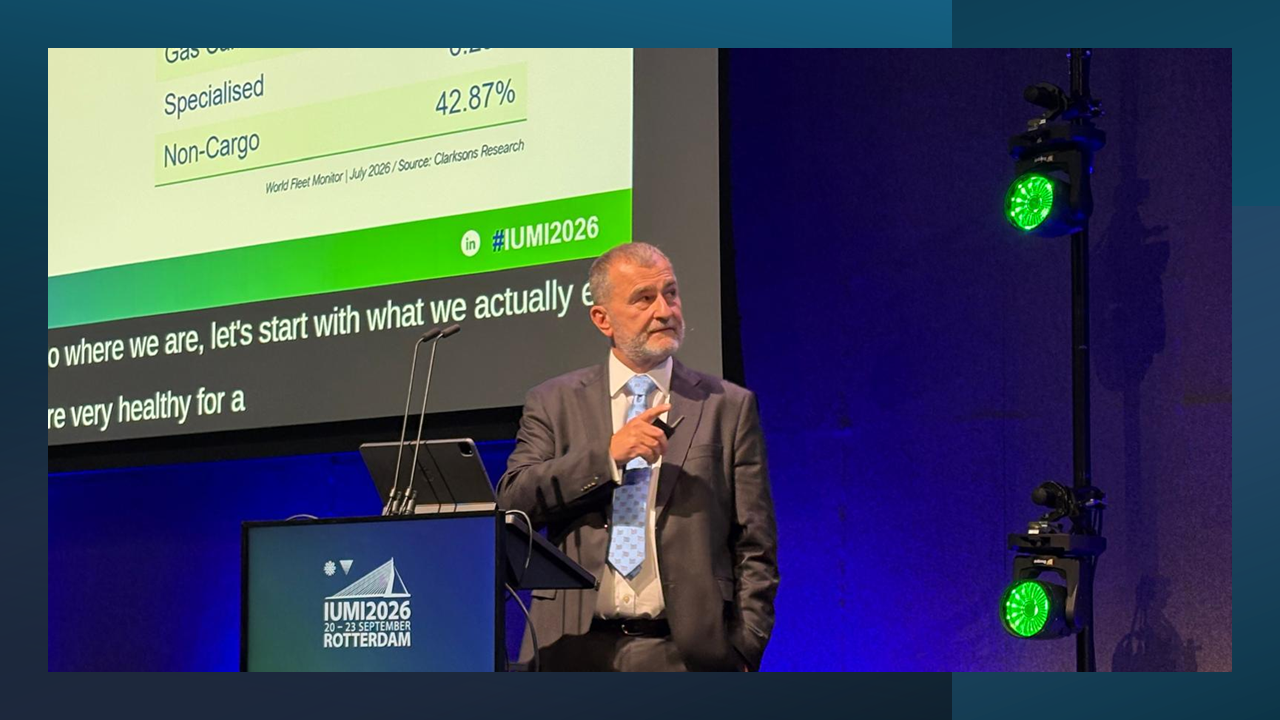
Speaking at IUMI’s annual conference in Rotterdam, Michele Cibrario, Chair of IUMI’s Offshore Energy Committee, reported that global offshore energy premiums totalled USD 4.8 billion in 2025, representing an increase of just 0.1% on the previous year. This figure is likely to include some double-counting due to local (i.e. domestic) policies placed in the London market and retrocession.
The London market, comprising Lloyd’s and the International Underwriting Association (IUA), continued to dominate, accounting for approximately 60% of global offshore energy premium, a share that remained broadly stable during 2025.
Cibrario cautioned that reported premium growth across some regional markets should be viewed in the context of currency movements and the international reinsurance structure.
Despite headline increases reported in some markets, the overall offshore energy market remained highly competitive throughout 2025, with capacity continuing to exceed demand, as many insurers remained focused on growth despite ongoing pressure on profitability.
The claims environment was relatively benign, with no major losses of sufficient magnitude to materially affect the wider market. However, attritional claims continue to rise and are steadily eroding underwriting profitability, leaving the sector increasingly exposed should a major catastrophic event occur.
The absence of significant large losses was reflected in overall loss ratios, which remained at very low levels at the start of 2025. These ratios are expected to develop as claims mature over time. 2026 loss activity is trending higher compared to this time last year.
Looking ahead, Cibrario highlighted a likely increase in capital expenditure across the energy sector during 2026, driven largely by concerns over energy security.
Many offshore sites have yet to return to full operation following the disruption caused by geopolitical events. As investment and redevelopment gather pace, insurers are likely to see renewed exposure to construction, testing and commissioning risks.
Renewables also represent a significant opportunity, although profitability remains challenging. Of the total offshore energy premiums within the London market, 30% represent renewables and the scale of future investment is substantial.
Approximately two-thirds of the USD 3.3 trillion globally invested in energy in 2025 were directed towards renewable energy and 2026 is widely expected to confirm such a trend.
Summing up, Cibrario said:
“The global energy market is entering a period of major investment, driven by energy security, geopolitical tensions and the transition to lower-carbon energy. Investment across oil and gas, LNG and new energy infrastructure is increasing the value and complexity of the risks that insurers cover.”
“At the same time, energy insurance is facing growing pressure on profitability. Inflation is increasing repair and business interruption costs, while rising attritional losses and longer-term construction risks are adding to claims. Competition, abundant capacity and limited major losses have also kept prices under pressure. More interconnected infrastructure is increasing accumulation risk, while changes in ownership, government policy and subsidies are adding further uncertainty.”
“This creates a clear challenge for energy insurers: the amount and complexity of risk is growing faster than the market’s ability to assess risks appropriately. The priority is therefore not simply to write more business, but to achieve sustainable growth through educated underwriting, effective accumulation management and prudent use of reinsurance. For energy insurers, success will depend on understanding the increasingly complex, interconnected and long-term risks being assumed.”
Related topics