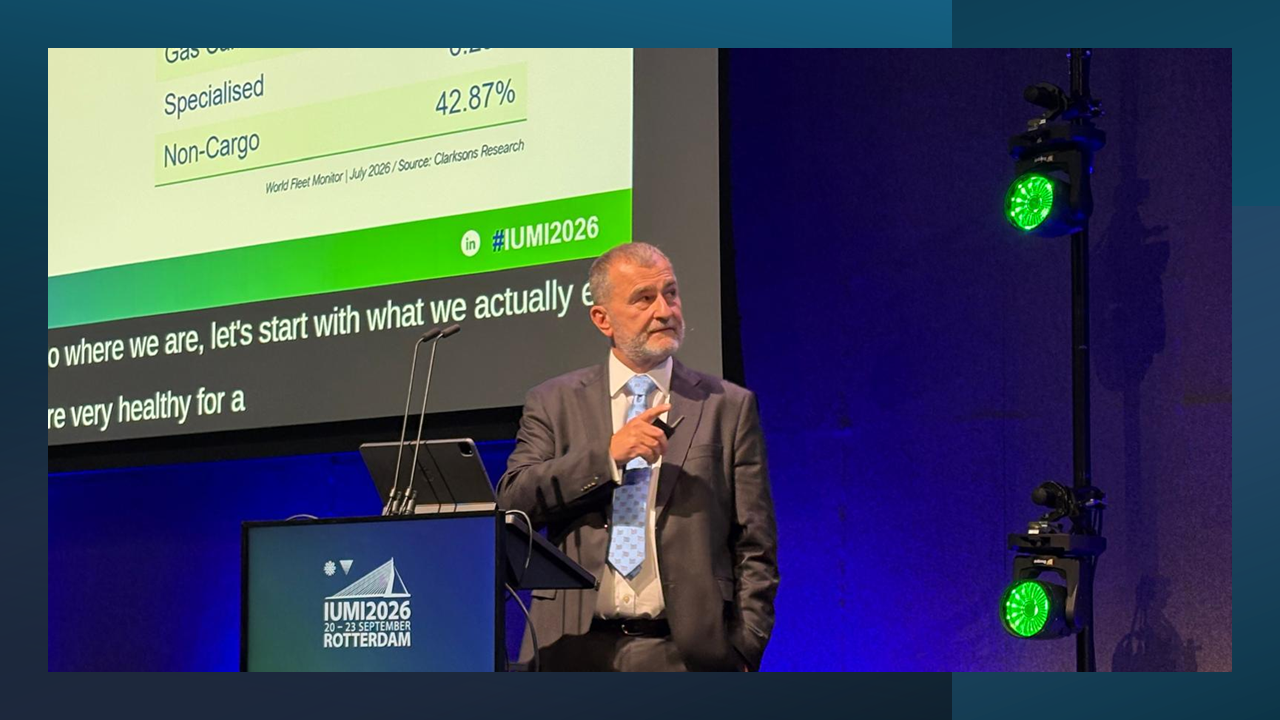


Global marine insurance premium income increased by 5.5% in 2025 to USD 42.6 billion, according to the latest market analysis from the International Union of Marine Insurance (IUMI), presented today at its annual conference in Rotterdam.
The headline increase, however, masks a continuing soft market across most marine insurance business lines, IUMI said. Currency movements, increased capacity and competitive pressures have all contributed to underlying market conditions remaining challenging.
Global premium income in 2025 was distributed across the major marine insurance regions as follows: Europe 46.5%, Asia/Pacific 30.8%, Latin America 10%, North America 7.2%, Middle East 3.5% and Africa 2.1%.
Transport/cargo remained the largest business line, accounting for 57% of global premiums, followed by ocean hull at 24.7%, offshore energy at 11.1% and marine liability, excluding P&I business covered by the International Group of P&I Clubs, at 7.3%.
Commenting on the figures, IUMI Chief Analyst Veith Huesmann said:
“Changes in marine insurance premium income are generally driven by factors such as global trade volumes and commodity prices for cargo, vessel values for hull and oil prices and activity levels in the offshore energy sector.”
“Although we report an increase in global premium income, 2025’s reporting figures are heavily supported by exchange rate effects. The weakness of the US dollar has had a significant impact on the global figures, with major reporting currencies appreciating by around 7-13%. Once currency effects are taken into account, the market remains soft across all major business lines, with increased capacity adding to competitive pressure in most sectors.”
“The claims environment has remained relatively stable, with no catastrophic loss significantly affecting any sector of the market. However, attritional losses continue to build and are eroding profitability, particularly in ocean hull.”
“More broadly, tariffs have not acted as the brake on global trade that some commentators had predicted, while stronger-than-expected global GDP growth has been broadly positive for marine insurance. We can also observe first signs of the AI race with high value semiconductors being traded. An effect that we’ll observe even more so in next year’s figures.”
“The most significant market development continues to be in Asia, where premium income has grown steadily since 2016, with China firmly in the driving seat. European growth has continued but is increasingly being outpaced by Asia.”
Cargo
Cargo insurance continues to account for the largest share of the global marine insurance premium base. In 2025, cargo premiums reached USD 24.2 billion, representing 57% of the global total and an increase of 6.9% on 2024.
Cargo premiums are closely linked to global trade activity, as well as movements in asset and commodity prices. As in previous years, the Chinese market was a significant driver of growth, supported particularly by new products deriving from an increasing of national e-commerce and return-insurance schemes but also high value exports such as EVs (electric vehicles), PVs (photo voltaic) and lithium batteries. Chinese cargo premiums increased by an impressive 19% in 2025, significantly outpacing other national and regional markets.
Asia now accounts for 36.4% of the global cargo market. Europe retains the largest regional share at 37.6%, but the gap between the two regions continues to narrow. The difference in premium share was just 3.3% percentage points in 2025, compared with 7.8% percentage points in 2024.
Loss ratios in Europe continued to trend downwards, reaching around 40% in 2025. Latin America has improved marginally since 2017, with loss ratios at around 45%. Asia reported loss ratios just below 70%, continuing an upward trend since 2020. In the United States, the reported loss ratio fell significantly, from around 75% in 2024 to approximately 40% in 2025, although this may partly reflect under-reporting.
The absence of major catastrophic losses in 2025, combined with largely contained attritional losses, contributed to a stable claims environment. Nevertheless, competitive pressures and continued influx of capital by MGAs continued to soften the global cargo market.
Ocean Hull
Global ocean hull premium income reached USD 10.5 billion in 2025, an increase of 9.4% on the previous year.
Europe remains the dominant market, accounting for 51.3% of global ocean hull premiums. The gap between Europe and its closest competitor, Asia, has continued to widen since 2020.
China has maintained its strong growth trajectory since 2016, complementing its position as a major cargo insurance market. Much of this growth reflects the increasing volume of Chinese newbuild tonnage being insured domestically. By contrast, the strong growth recorded by the Nordic markets in recent years appears to have moderated.
Despite the increase in headline premium income, global fleet growth continues to outpace growth in the ocean hull premium base – a trend that does not indicate a strengthening market.
Loss ratios in Europe appear to be returning towards more normal levels following the post-Covid period, with the 2025 estimate at around 60%. Asia reported a loss ratio of approximately 50%, an increase on 2024, while Latin America experienced a significant reduction. The US market also continued to improve, with a reported loss ratio of around 50% in 2025.
Global fleet growth continues, although at a slower pace than in previous years, and is expected to reach approximately 3% by the end of 2026. At the same time, the continued ageing of the global fleet is becoming an increasing concern. The average vessel age has now reached 22.4 years, with maintenance and repair costs increasing and spares becoming less readily available.
As with the wider marine market, the positive headline growth in ocean hull premiums needs to be viewed in the context of currency movements and fleet growth. Some markets can’t separate war premium from bluewater hull as reportings often combine these products. With attacks in the Red Sea war premiums have already driven some figures in 2025, a trend that will impact 2026 even more so. Once these factors are taken into account, the underlying market remains relatively soft.
Offshore Energy
Global offshore energy premiums reached USD 4.82 billion in 2025, virtually unchanged from the previous year, with growth of just 0.1%.
The UK continues to dominate the global offshore energy market, accounting for a stable 62.7% share of premiums. The UK also accounts for around 30% of the global renewables insurance market which is rough estimate of where the market stands. An increasing share of renewables is very likely in the coming years.
Offshore energy remains in a prolonged soft market cycle, now entering its sixth or seventh year. The absence of major losses has contributed to low loss ratios at the beginning of 2025, although these are expected to develop as claims mature.
Looking ahead, the global energy sector is entering a significant investment cycle, driven by energy security concerns, geopolitical tensions and the transition towards lower-carbon energy sources. This is increasing both the value and complexity of risks facing insurers.
At the same time, inflation, rising claims costs, excess capacity and competitive pricing continue to place pressure on profitability.
The offshore energy market therefore remains firmly in a soft phase, despite the significant structural changes and investment opportunities emerging across the global energy sector.
Summing up, Jun Lin, Chair of IUMI’s Facts & Figures Committee, said:
“Geopolitical uncertainty continues to affect all marine insurance business lines, while inflationary pressures, largely driven by oil prices, are adding to the challenges. We have yet to see any significant impact on consumer confidence in the data, but this may emerge over time.
The depreciation of the US dollar is also having a global impact. It has the potential to mask an underlying softening of the insurance market and, depending on the currencies in which claims are paid, can also increase claims costs.
At the same time, we are seeing record levels of insurance and reinsurance capacity, intensifying competition and putting further pressure on profitability.
On the positive side, seaborne trade continues to grow, as does the global merchant fleet. Capital expenditure in offshore oil and gas and renewables is also increasing, while insured values and charter/day rates are generally rising.
Despite growth in the global premium base, significant headwinds remain across all marine insurance lines and the overall market continues to be soft.”
Ends
Related topics